

Toga Party
Greek and Roman Art at the Met
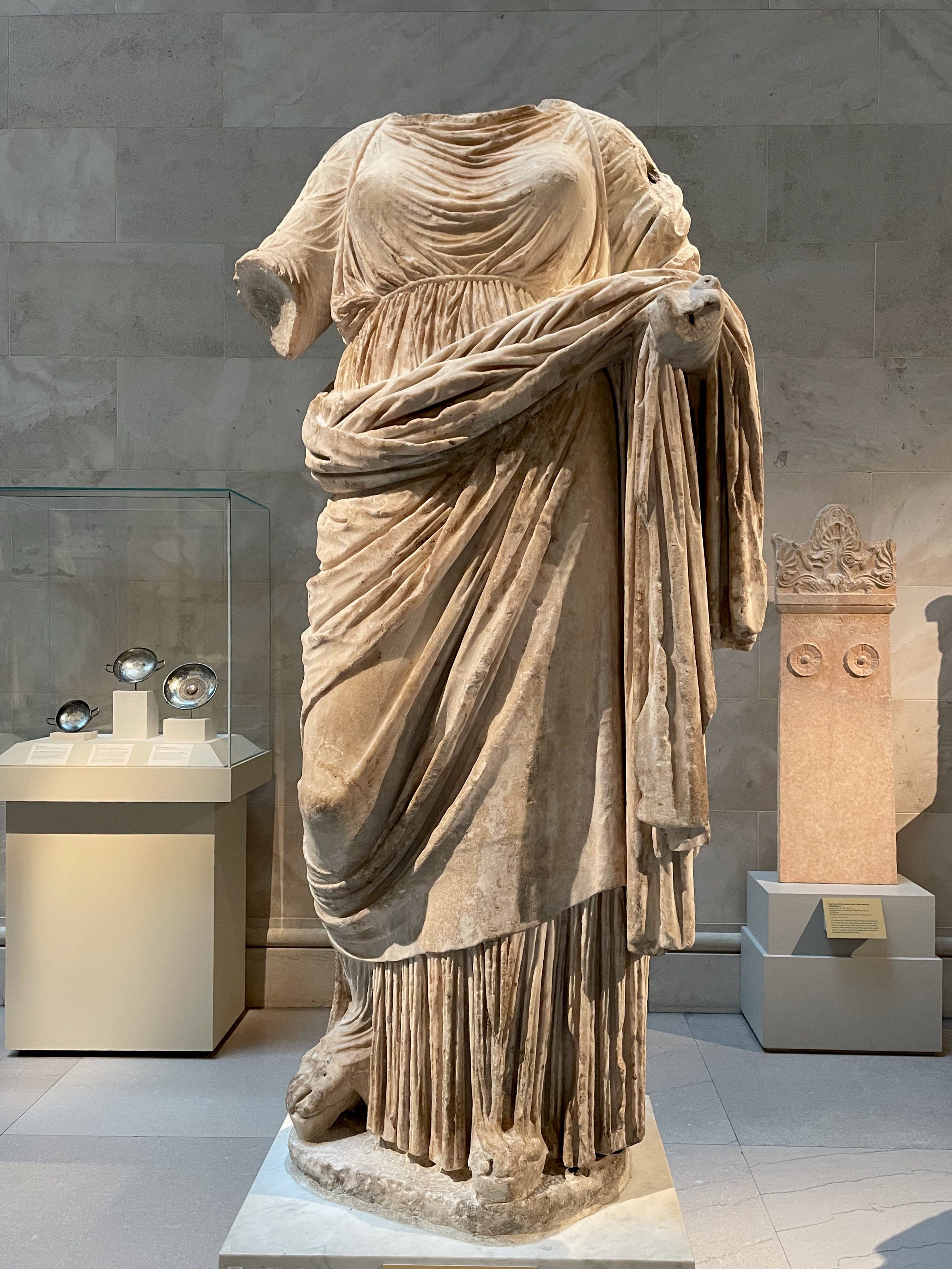
Now that I’ve finished the Michael C. Rockefeller Wing, there’s just one department left to explore on the first floor of the museum - then I (or we, since I’m bringing you all along) can move up to the second floor. Progress! So this week I started attacking the Met’s twenty galleries of Greek and Roman art, located in the southeast corner of the first floor. When I caught a glimpse through the enfilade of galleries and saw nothing but off-white, cream, beige, and ecru, I had a flashback to the Ancient Egypt department, which was also dominated by a limited color palette and (what seemed to me) exhausting repetition.
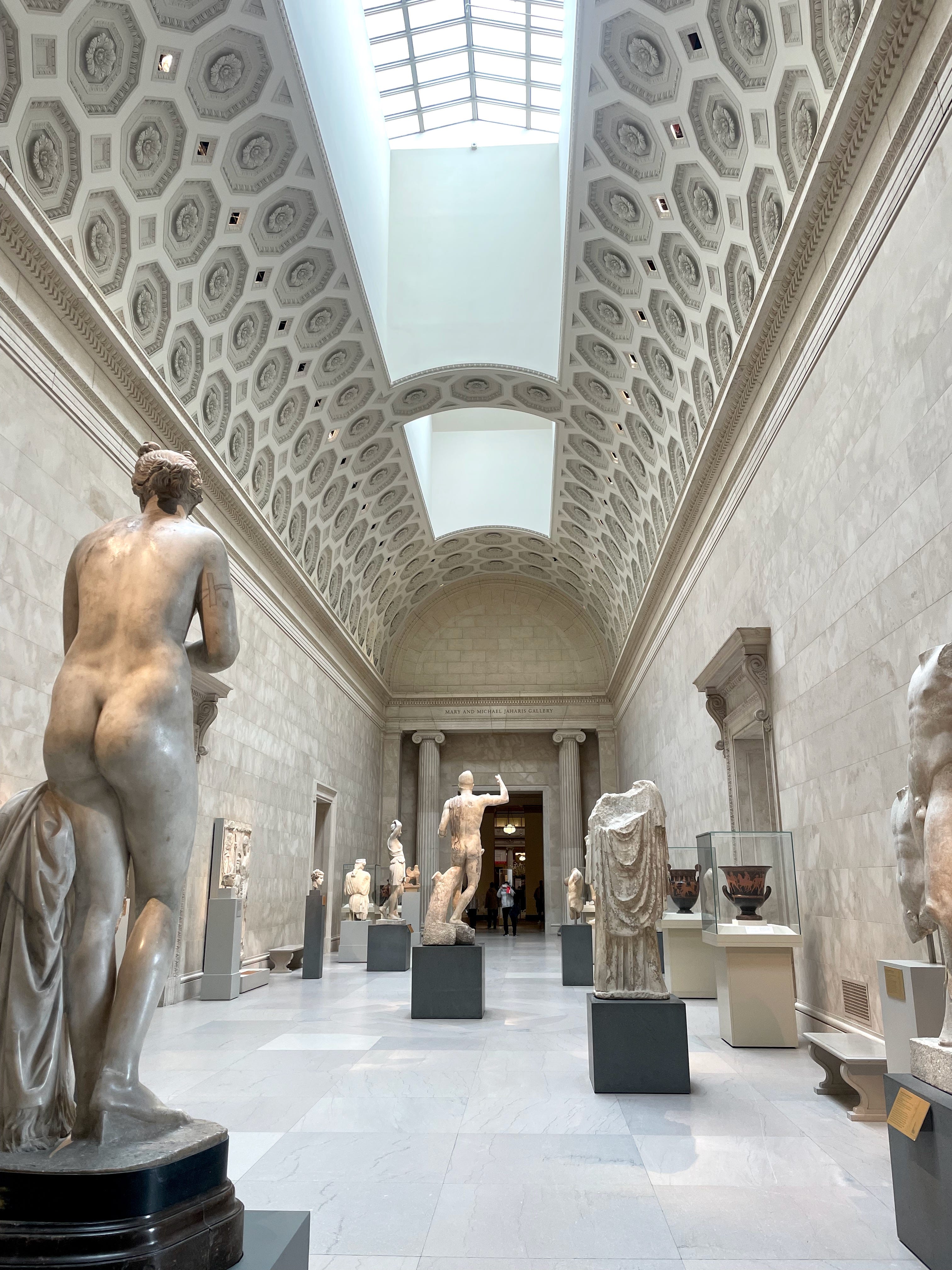
But there were gems to be discovered and history to be (re)learned, so I pressed on.
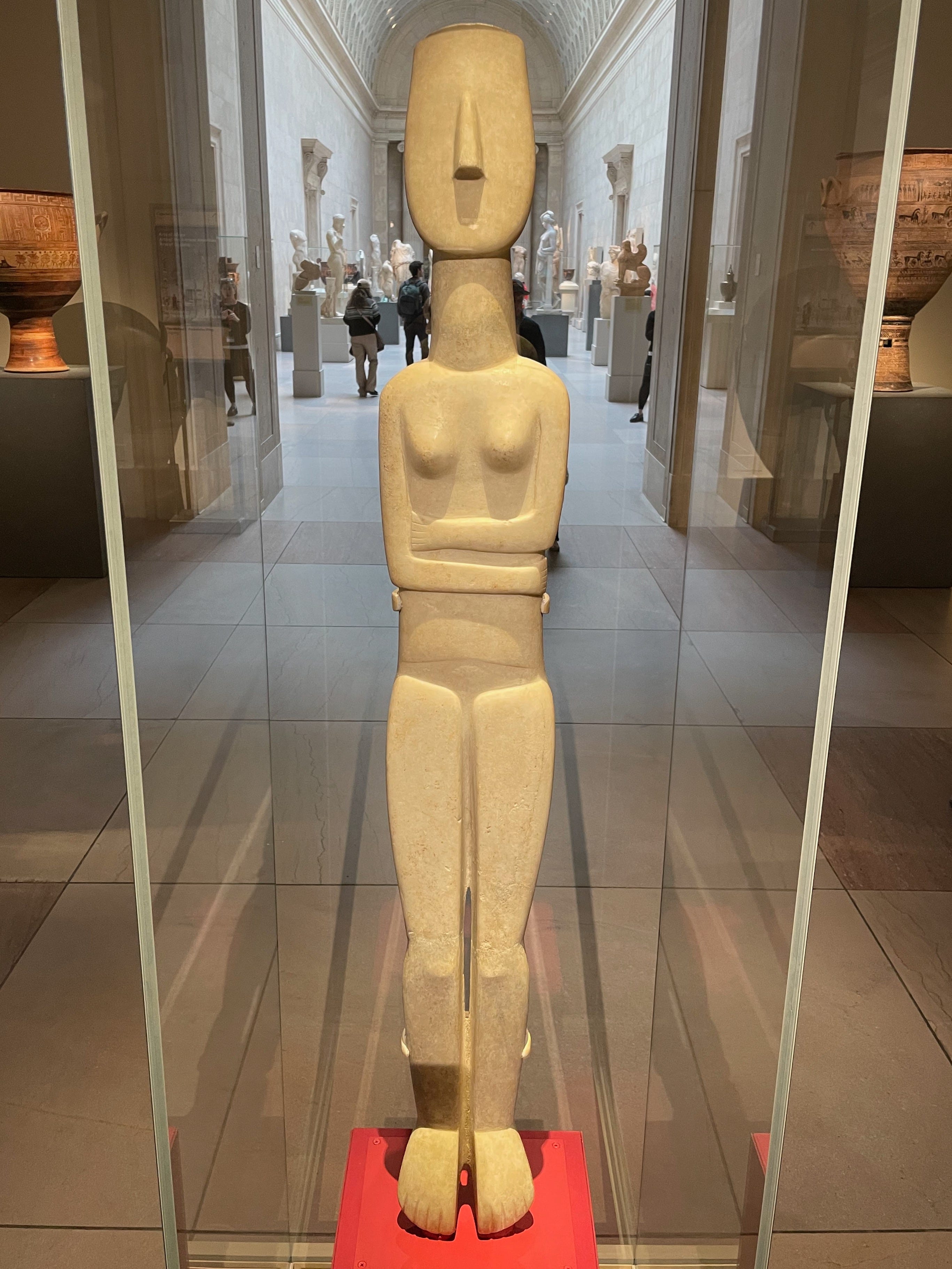
Gallery 150: Prehistoric and Early Greek Art
Highlighted artwork – Female figure, marble, 52” tall, Cycladic, 2700-2300 BCE. I loved this figure so much I forgave her for being beige. She greets you as you enter the Greek and Roman galleries just off the main entrance of the museum - you can’t really proceed to the grand skylit gallery beyond without stopping to admire her. Female figures with crossed arms and minimal facial features are so common in Cycladic art that archeologists refer to them as FAFs, or “folded arm figures”; an adjacent gallery holds dozens of them, but at more than four feet tall, this is one of the largest known examples.
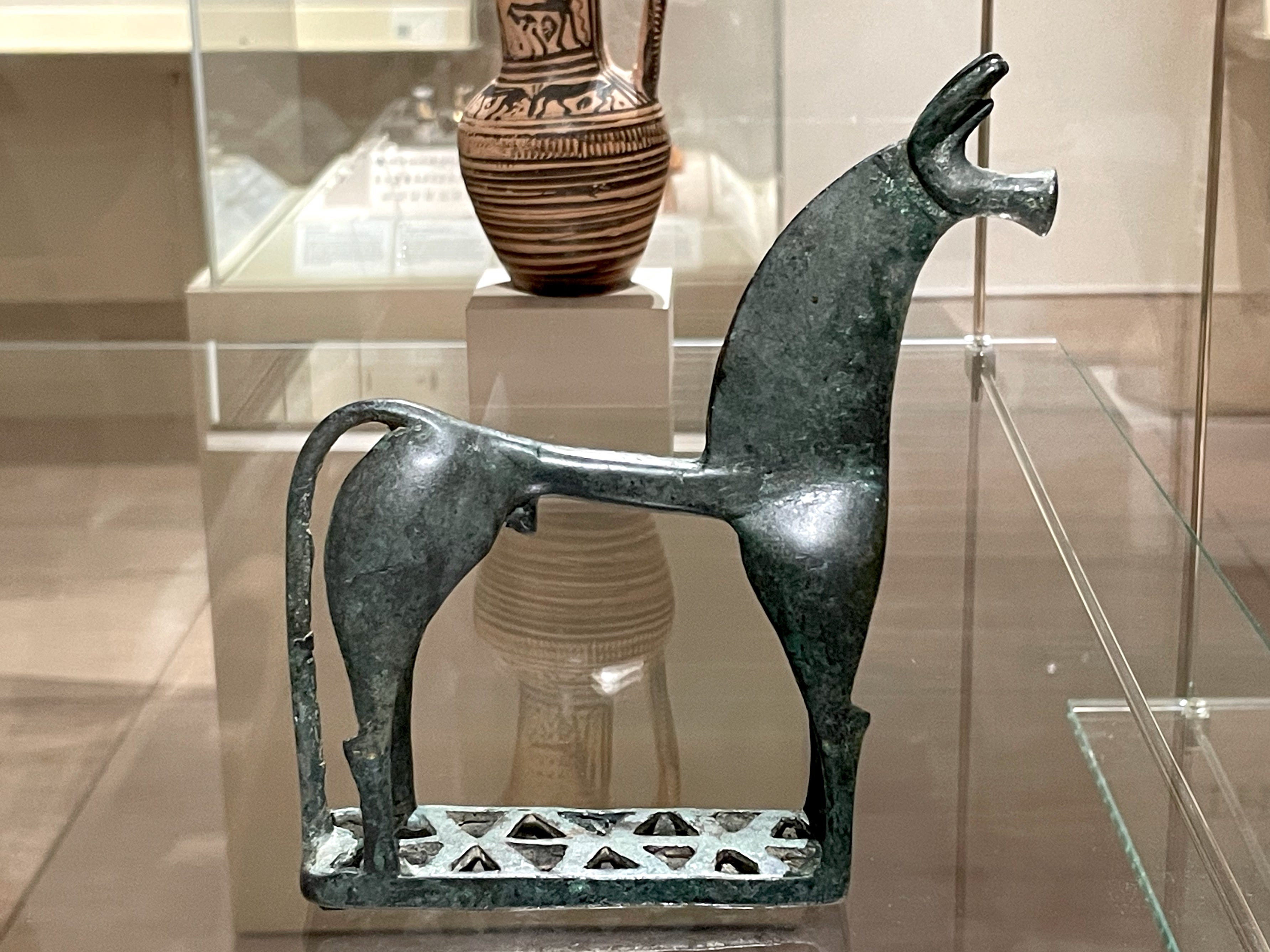
Gallery 151: Prehistoric and Early Greek Art – Fifth Millennium–700 BCE
Highlighted artwork – Horse, bronze, 7x5x1.5”, Greek, probably Corinth, 8th century BCE. I was drawn to the graceful form of this horse, which seems to exude power despite its diminutive size. Small bronze horses like this one have frequently been found at Greek sanctuaries, where they were left as offerings to the gods. Like the Cycladic figure above, something about it immediately reminded me of Picasso, who was heavily influenced by ancient Greek art. One of the many rewards for this painstaking exploration of the museum is the frequent reminder that every artistic movement builds on its predecessors, whether twenty years or millennia earlier.


Gallery 152: Greek Art – Seventh-Sixth Century BCE
Highlighted artwork – Aryballoi (perfume bottles), terracotta, 3-6”, Rhodes, 6th century BCE. The cases in this gallery hold dozens of perfume bottles in a variety of forms, from monkeys to hedgehogs to the shapes pictured here (am I the only one who’s reminded of the lamp in “A Christmas Story”?). In addition to personal scent - the quality of which indicated your status - perfume had religious and funerary uses in ancient Greece; athletes applied scented oils before competition, believing it gave them strength and divine protection - so I suppose it was an early form of doping.
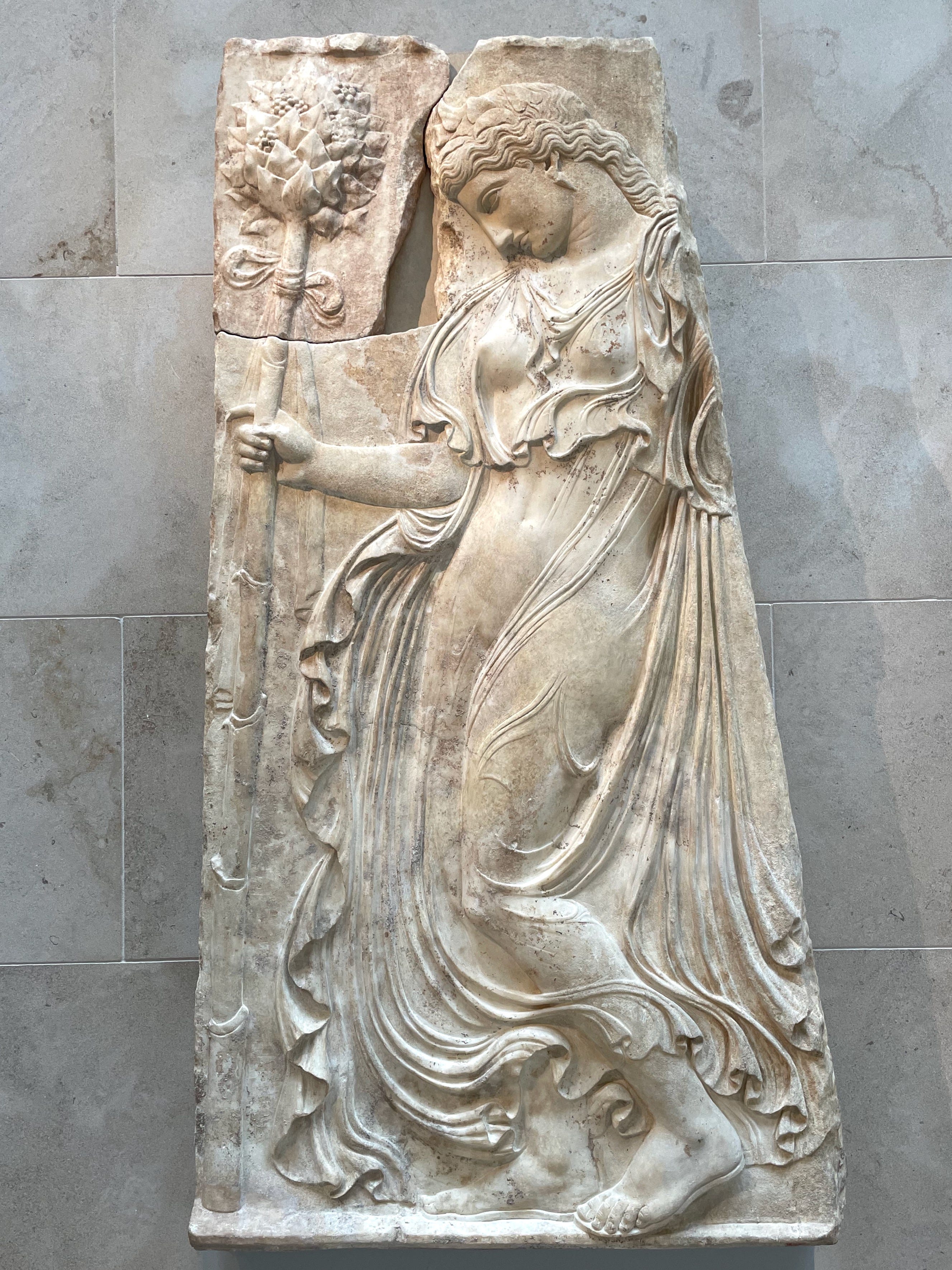
Gallery 153: Greek Art – Sixth–Fourth Century BCE
Highlighted artwork – Relief with dancing maenad, marble, 56.5” tall, Roman (copy of an earlier Greek original), 27 BCE-14 CE. This central gallery with a coffered, barrel-vaulted ceiling (pictured at top) is a lovely space to rest on a bench and contemplate all that Greece has bequeathed us, from marble statuary to spanakopita. But none of the artworks really grabbed me, so I settled on this relief of a maenad, mostly for the beautifully flowing drapery of her gown. Maenads, the mythical followers of Dionysus, the god of wine, were led into intoxicated frenzies of dancing, abandoning their families to roam the forests and mountains. But who among us hasn’t occasionally fallen into a dance frenzy after a few glasses of wine?
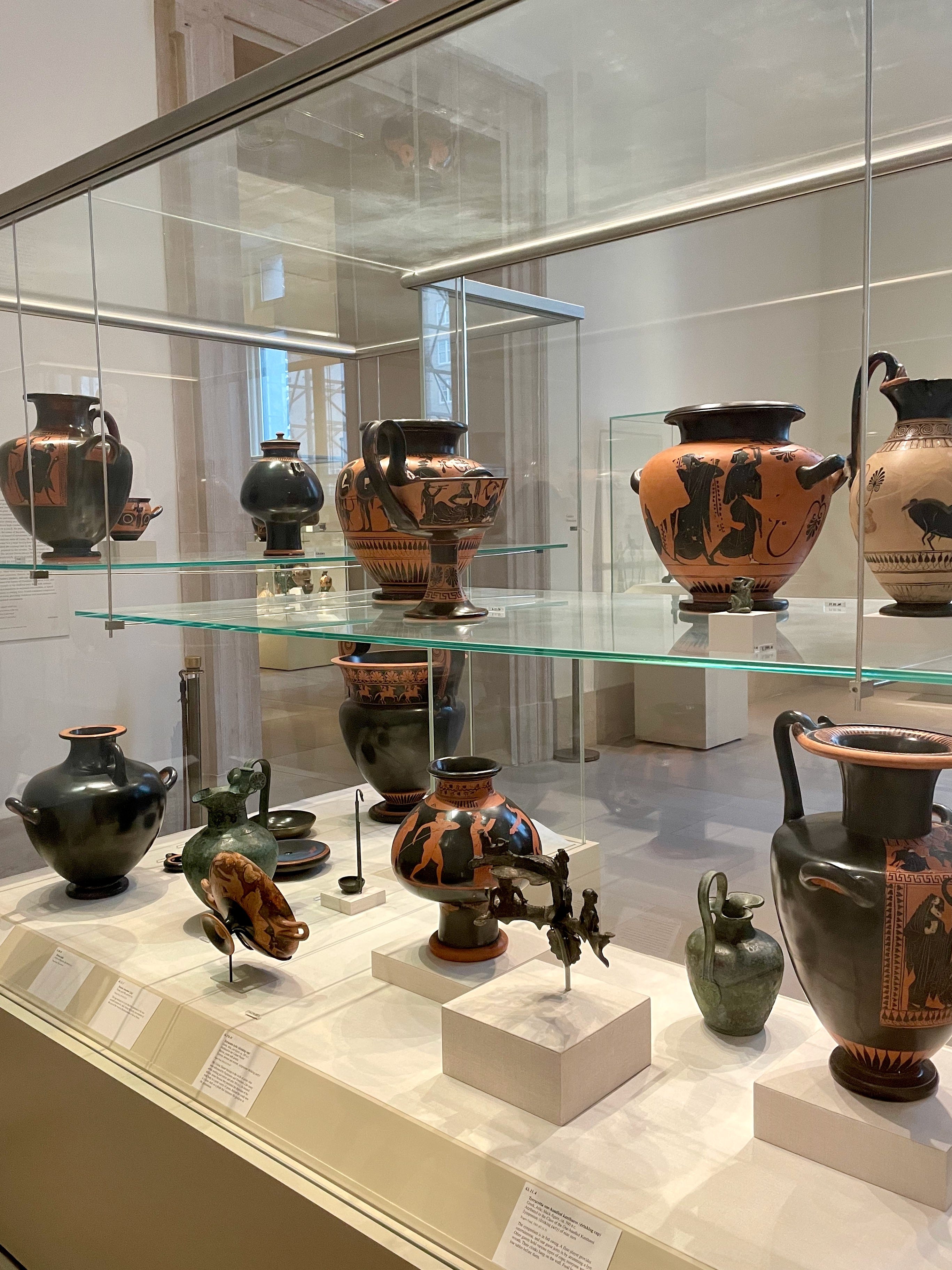
Gallery 154: Greek Art – Sixth Century BCE
No highlighted artwork – I tried to photograph a few pieces in this room, but was foiled by the reflected spotlights on the curved vessels, which obscured the images painted on them. Suffice it to say, this gallery holds several dozen terracotta bowls and vases portraying various mythological scenes.
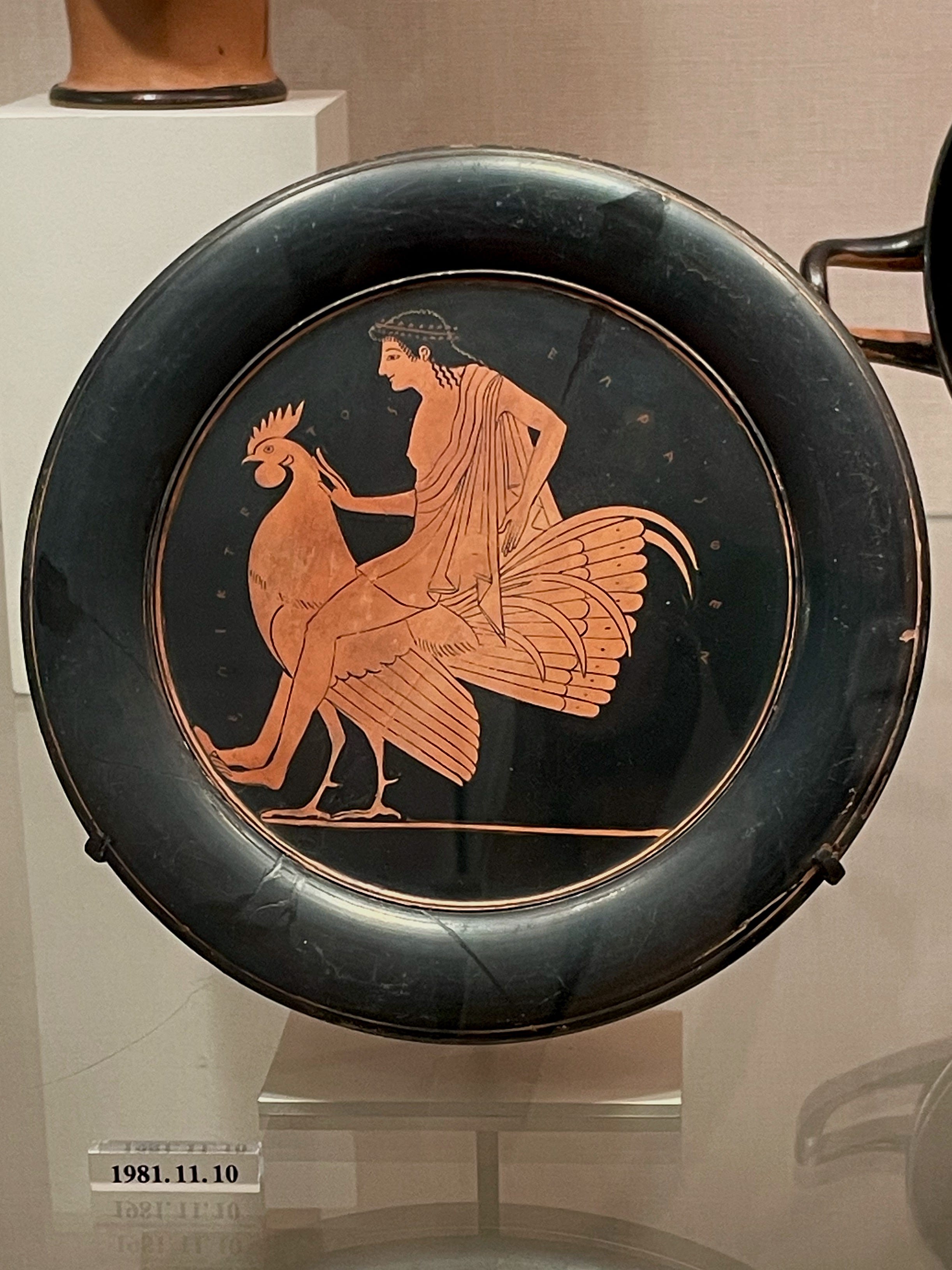
Gallery 155: Greek Art - Sixth Century BCE
Highlighted artwork - Terracotta plate, red-figure terracotta, 7” diameter, Greek/Attic, 520-510 BCE. It’s a youth riding a rooster - what’s not to love? The plate is signed by Epiktetos, who preferred painting scenes of daily life to mythological figures - but I have to assume that a boy riding a giant rooster was not an everyday sight on the streets of Athens; scholars aren’t certain of the meaning of this image, other than an allusion to the rooster as a “love gift”. I prefer flowers, thanks.
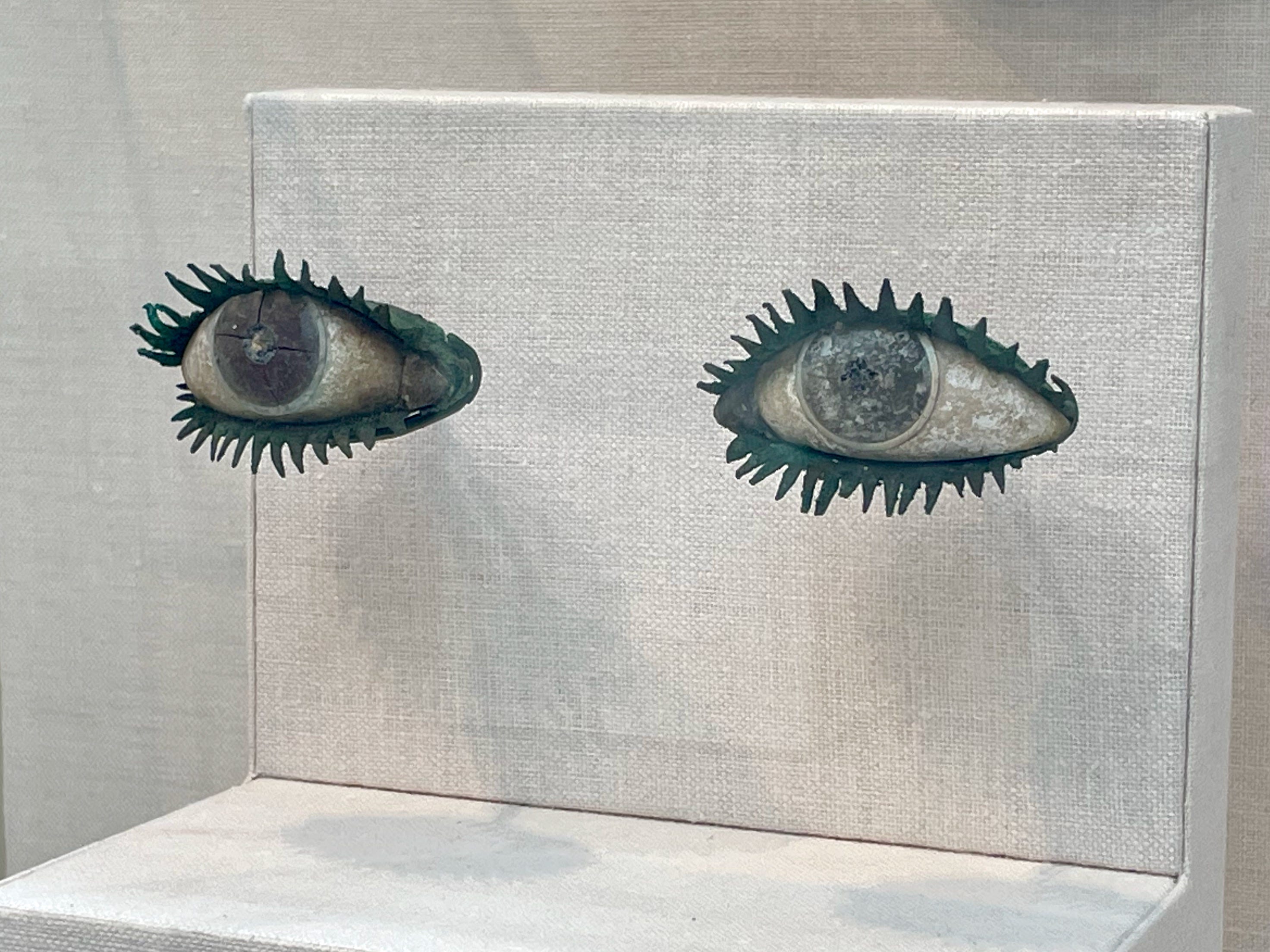
Gallery 156: Greek Art – Fifth Century BCE
Highlighted artwork – Pair of eyes; bronze, marble, frit, quartz, obsidian; 1.5x2”, Greek, 5th century BCE. Though these eyes were made to fit into the face of an oversized marble statue, I thought they were perfect as is - surreal, creepy, and worthy of Man Ray or Duchamp. Although we associate ancient Greek statues with pristine white marble, they were in fact brightly painted to appear more lifelike, and sometimes inlaid with precious metals and gemstones - or bronze eyes like these - to emphasize their facial features. Most artifacts and architectural fragments displayed in museums today have lost their pigment over the centuries, but enough traces remain that historians have reimagined Athens as a very colorful city. Nonetheless (and despite my complaints about the lack of color in these galleries), it strikes me as sacrilege to paint over such elegant stone - but who am I to question the artistic decisions of the Greek masters?
Gallery 157: Greek Art - Fifth Century BCE
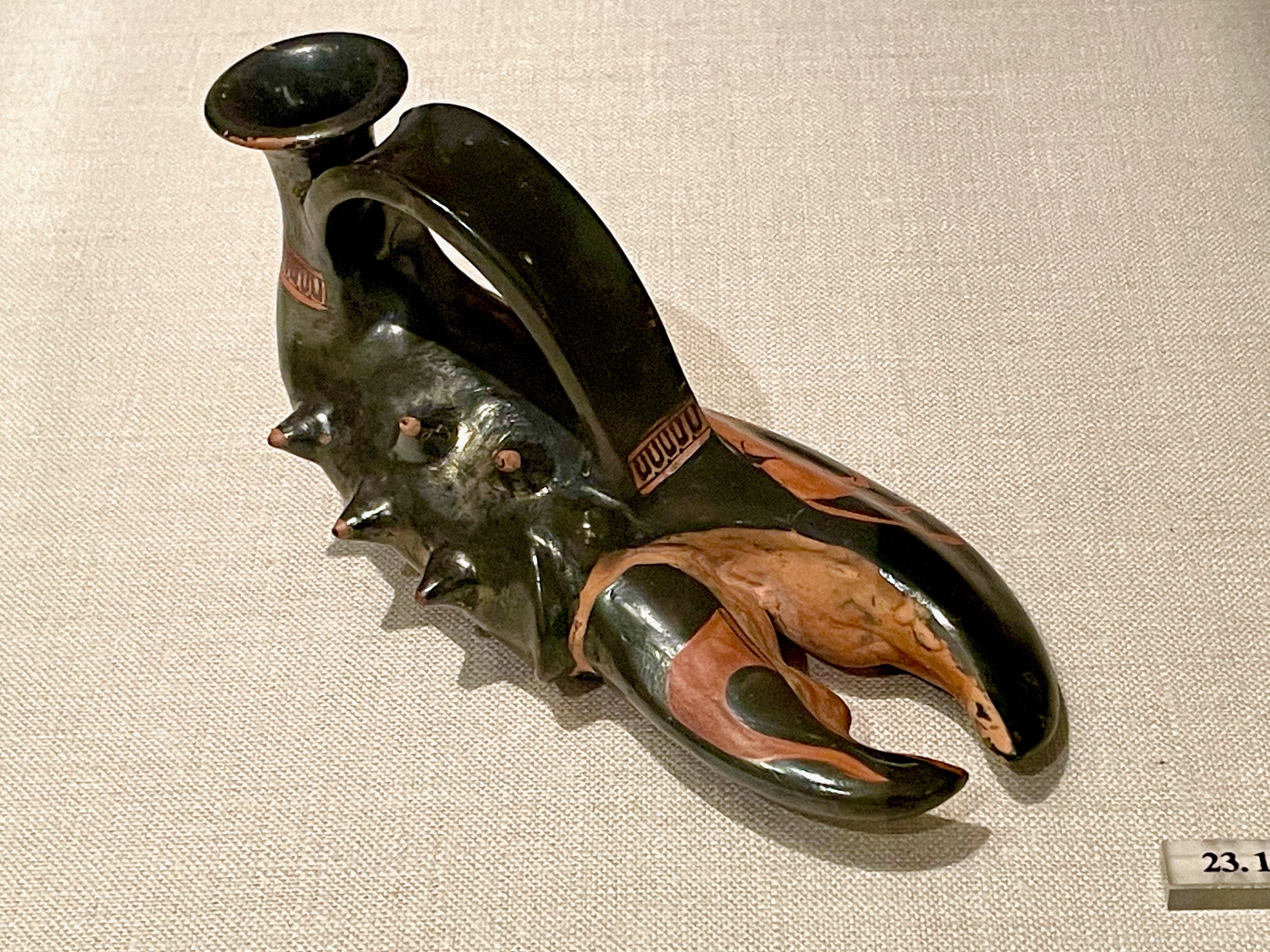
Highlighted artwork - Vase in the form of a lobster claw, red-figure terracotta, 6x2.5x3”, Greek/Attic, c. 460 BCE. Sealife themes weren’t unusual in Greek artwork, but this vase is thought to be a novelty, likely made to be used at a symposium - which in ancient Greece was not an academic conference, but a drinking party that involved music and dancing. Some symposia were highfalutin affairs, with poetry readings and elevated conversation; others involved games such as kottabos, in which players swirled the dregs of their wine in a kylix (a wide two-handled cup) and flung them at a target (proto-beer pong, perhaps?).
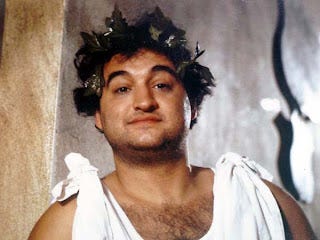
For anyone too young to remember the 1978 classic frat comedy “Animal House”, it’s worth watching for the toga party scene alone.
I could totally see your Maenad beauty at the Met Gala in a few months!
I haven't been to the Greek art at the Met in forever. Though beige, the photo of that great skylit hall...stunning. Now I want to go back! Just to sit and think quietly. (Tho' I bet it echoes profoundly if one dares to speak in it.)
On Milos, many years ago, I went to the Cycladic art museum, which, at that time, was tiny. And the sculptures were miniature-sized, could fit in the palm of your hand or smaller. Now we know where the more robust ones went....
Great selections! As always, Margaret!